There is nothing as invigorating as the mighty Iron Horse.
THE STEAM LOCOMOTIVE has inspired millions of people throughout history –
and Nashville, Chattanooga & St. Louis Railway No. 576 is about to inspire thousands more.
NASHVILLE STEAM is undertaking the restoration and operation of a Nashville legend.
The adventure departs now. Will you climb aboard The Stripe?
FOLLOW US ON FACEBOOK
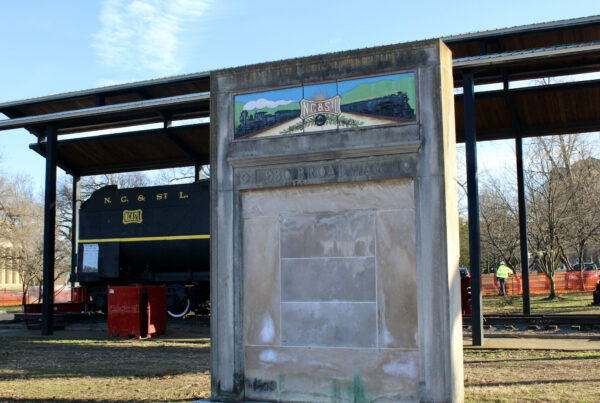
Congratulations to our friends at the Fort Wayne Railroad on relocating New York Central No. 3001 and beginning its journey toward restoration! We're proud that folks from our team were on hand throughout the prep and relocation to lend a hand.This event recalls the path Nashville Steam embarked upon with NC&StL No. 576 in 2019 when we moved an irreplaceable Nashville icon, assembled a dedicated team, and began the meticulous process of returning a landmark of American steam power to operation.Built only two years apart by the American Locomotive Company, these engines are fascinating counterparts. No. 3001 is a 1940 New York Central L3a 4-8-2 Mohawk, while No. 576 is a 1942 Nashville, Chattanooga & St. Louis J3 4-8-4. Both were advanced dual-service locomotives with 250-pound boiler pressure, nearly identical cylinder dimensions, roller bearings, cast-steel frames, and driving wheels at both 69 and 70 inches in diameter, respectively. Each reflected its home territory. The 69-inch-drivered Mohawk combined freight-engine adhesion with the balance and horsepower needed for fast passenger service across the New York Central system. The 70-inch-drivered 576 used the larger firebox afforded by its four-wheel trailing truck to sustain both heavy freight and passenger schedules across the grades and curves of the Dixie Line.No. 3001 produced slightly greater starting tractive effort; No. 576 became renowned for reliability and extraordinary availability. Together, they represent two compelling solutions to the same challenge: building one locomotive capable of doing almost anything. And in their era, they did it fast. Both were formidable high-speed locomotives: The NYC L3a class was engineered for 80-mph passenger service, while the NC&StL’s J3s sometimes reached 90 mph — and one was recorded at an extraordinary 110 mph.Nashville Steam knows just how much patience, precision, skill, and perseverance lie ahead, but it's also not Fort Wayne's first ride at the rodeo! Highball to the Fort Wayne team on this tremendous first step. We will no doubt be busy with 576, but we look forward to watching another remarkable ALCO locomotive return to life.Here’s to the long road ahead and to the day when Nos. 3001 and 576 can once again speak for the ingenuity of American steam.
We join our friends across Tennessee, the South and the world as we mourn the loss of one our region’s most influential people, Miss Dolly Parton. Her achievements both professionally and in the community are numerous, but we are especially thankful for her commitment to bring the joy of steam to new generations in the mountains of East Tennessee. Our hearts are with the Parton family and all of those whose lives were made better by the actions of this incredible individual. We will always love you, Dolly. 🦋“As we roll along the mainline, there'll be storms and there'll be night,There'll be sidetracks unexpected, on the left and on the right,But with the straight always before us, and our hearts upon the prize,There'll be no disembarkation until we reach paradise.”
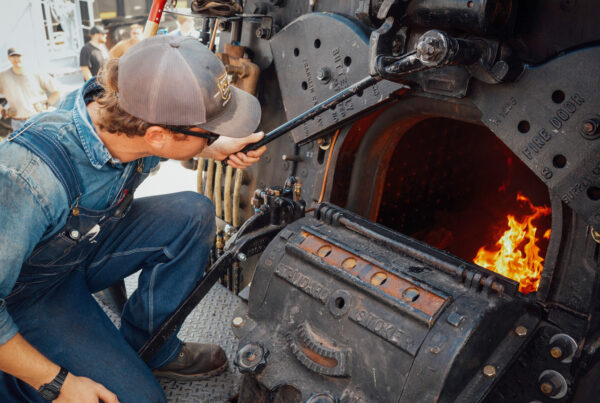
Thump, thump. Thump, thump. We were thrilled to hear that steady pulse after 74 years of silence!In addition to firing up No. 576 last month, our crew started testing the various appliances that have been fully serviced and reinstalled on the locomotive. The original cross compound air compressor (the NC&StL J-3 class only had one) was completely rebuilt thanks to a grant from the Emery Rail Heritage Trust with work completed by FMW Solutions. The air compressor creates the air needed to operate the train’s braking system as well as the air powered appliances on the engine, like the power reverser. The air pump is one of the most notable sounds on a steam locomotive. Many have likened it to a heart beat, it’s easy to hear why!🫀🚂